
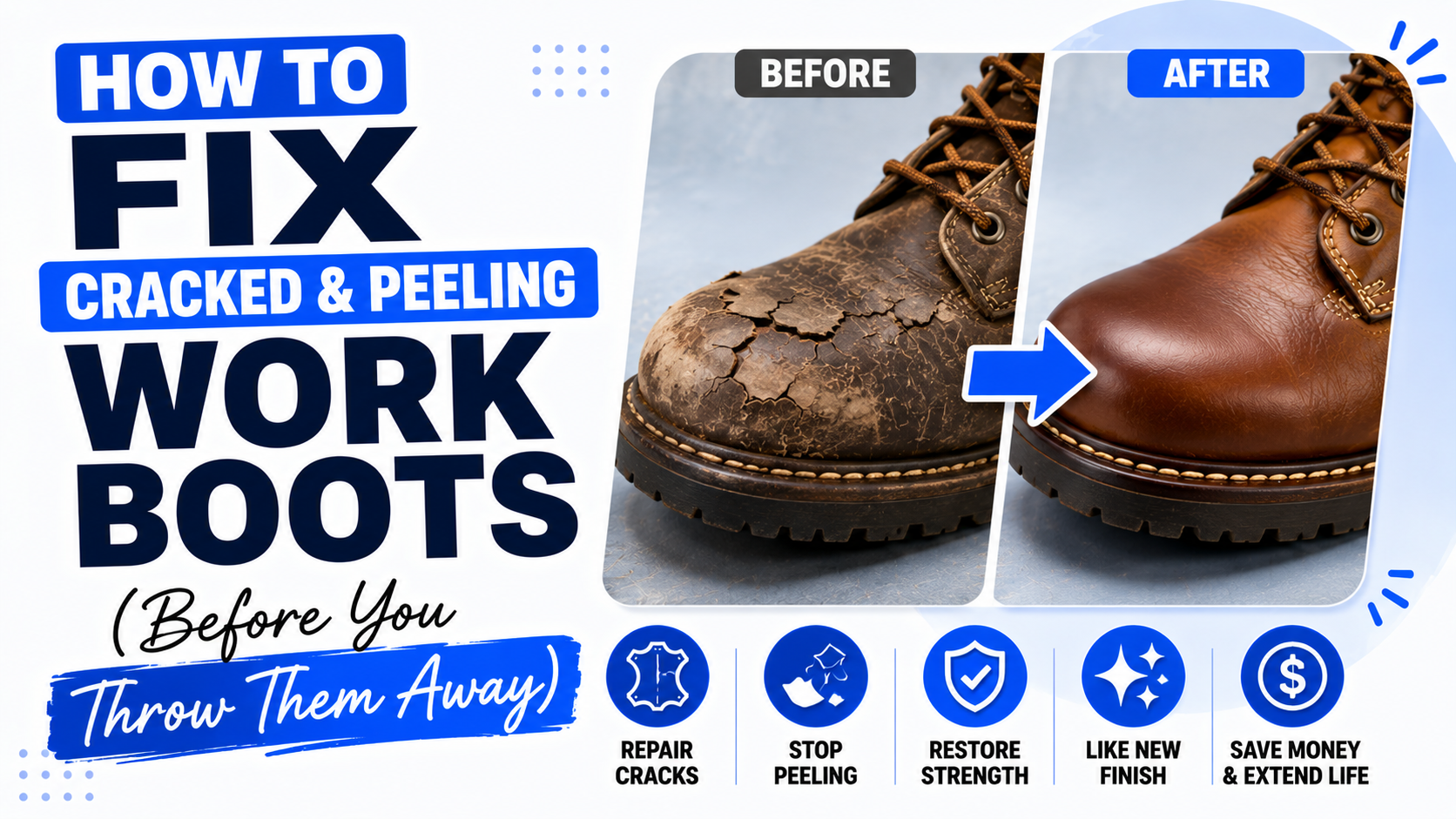
How to Fix Cracked and Peeling Work Boots (Before You Throw Them Away)
Work boots earn every crack and scuff they collect. Job sites, concrete, chemicals, weather, and long shifts put real stress on leather that dress shoes and casual boots never see. When the surface starts to crack, dry out, or peel at the toe and flex points, it can feel like the boots are finished. In many cases they are not. A cracked or dry-looking work boot can often be cleaned, conditioned, and resealed to add months or years of extra life, as long as the damage is caught before it becomes a structural problem.
This guide from Designer Trends INC explains how to tell the difference between surface dryness and serious structural damage, how to repair cracked or peeling leather at home, and how to protect work boots going forward so the same damage does not come back after the first hard week on the job.
Affiliate disclosure: This article includes affiliate links. If you buy through these links, Designer Trends INC may earn a commission at no extra cost to you.
Why Work Boot Leather Cracks and Peels
Cracking usually starts with dryness. Repeated wetting and drying cycles, whether from rain, sweat, or job-site chemicals, pull natural oils out of leather faster than they can be replaced. As the leather loses flexibility, the constant bending at the toe box and ankle creates stress lines that eventually become visible cracks. Peeling is slightly different and often happens on boots with a coated or corrected-grain finish, where the surface layer separates from the leather underneath after enough flexing, abrasion, or exposure to solvents and heat.
Cheap conditioners, silicone sprays not meant for leather, and direct heat from boot dryers or heaters can accelerate both problems. So can long periods of storage without any conditioning at all, since leather continues to dry out even when boots are not being worn.
Assess the Damage Before You Start
Flex the boot gently at the toe and ankle. If the surface looks dry and dull but does not visibly split, you are dealing with dryness that conditioner can likely reverse. If you see fine hairline cracks concentrated at flex points, the boot needs conditioning plus a protective coating to keep the cracks from spreading. If the coating is flaking off in visible pieces and you can see a different texture underneath, that is peeling, and it usually needs a repair coating rather than conditioner alone. If cracks run deep enough to reach the lining, or if the welt and sole are separating, that is a job for a cobbler or bootmaker rather than a home fix.
Step-by-Step Boot Repair Routine
- Remove laces and brush off all loose dirt and dust from the upper.
- Clean with a leather-safe cleaner to remove salt, oil, and grime from the cracked areas.
- Let the boots dry completely at room temperature.
- Apply leather conditioner to the entire upper, focusing extra product on dry or cracked zones.
- Let the conditioner absorb fully, then wipe away any excess so the leather does not feel greasy.
- Apply a flexible, waterproof boot guard coating over cracked or worn areas to seal and protect them.
- Let the coating cure fully before wearing the boots on the job.
- Repeat conditioning on a schedule that matches how hard the boots are worked.
For light cracking, conditioner alone can restore enough flexibility that the cracks become far less visible and stop spreading. For peeling or more advanced cracking, a dedicated brush-on boot guard is designed specifically to fill and seal damaged areas so moisture cannot get underneath and make the problem worse.
Recommended Products for Cracked and Peeling Boots
For boots with real cracking or peeling, ToeArmor makes a heavy-duty, brush-on boot guard built specifically to fix worn-out work boots. It is waterproof, flexible, and crack-resistant once cured, which makes it a practical option for job-site boots that are still structurally sound but showing visible surface damage. For the conditioning step before any coating goes on, the Eagle Shoe Care Amazon store carries leather conditioners and the Eagle Boot Wax Waterproofer and Conditioner, which softens dry leather and adds water resistance in one step.
Best buy for this repair
Condition first with Eagle Boot Wax Waterproofer and Conditioner, then seal visible cracks and peeling with a ToeArmor boot guard coating from the Designer Trends INC brand portfolio for a flexible, waterproof finish.
Does Boot Leather Type Change the Repair Approach?
Full-grain leather work boots tend to respond best to conditioning alone for early cracking, since the natural grain absorbs oil evenly and rarely peels the way a coated finish can. Corrected-grain or pigmented leather, common on many affordable work boots, has a thin surface coating that can peel or flake once it dries out, which is why a sealing boot guard coating matters more for this type than for full-grain leather. Suede or nubuck safety boots are a separate category entirely and should never be treated with boot wax, oil, or a boot guard coating designed for smooth leather, since these products can flatten the nap and leave permanent dark patches. If your boots combine a leather upper with synthetic panels or mesh, focus conditioner and boot guard only on the leather sections, and check the manufacturer's care guidance for the synthetic material separately.
When to Repair vs When to Replace
Repair is usually worth it when the sole, welt, and structural stitching are still intact and the damage is limited to the leather surface. A cracked toe box or a peeling vamp on an otherwise solid boot is a strong candidate for conditioning and a boot guard coating. Replacement makes more sense when the sole is separating from the upper, the steel toe or safety components are compromised, or cracks have progressed to full splits that expose the boot's internal structure. If you are unsure, a local cobbler can usually tell you in minutes whether a boot is worth repairing.
Preventing Future Cracking
Condition work boots on a regular schedule rather than waiting until they already look dry. Clean off mud, salt, and chemical residue as soon as possible instead of letting it sit and pull moisture from the leather over time. Avoid drying wet boots with direct heat, since fast drying is one of the most common causes of cracking in job-site boots. Rotate between two pairs if your job allows it, so each pair gets full drying time between wears. Our leather boot waterproofing guide covers the full seasonal routine in more detail.
Common Mistakes to Avoid
Do not apply boot guard coating over dirt or old wax, since it will not bond properly and may peel again quickly. Do not use household oils, cooking oil, or petroleum jelly as a substitute for real leather conditioner, since these can attract dirt and break down stitching over time. Do not dry cracked boots near a heater to speed up the process, as heat makes cracking worse. Do not ignore small cracks, since they tend to spread with continued flexing once moisture gets into the gap.
Backlinks and Related Resources
For more boot care guidance, read how to waterproof leather boots and how to make leather shoes last 10+ years. Explore the full Designer Trends INC brand portfolio to compare Eagle, Leather Hero, Fiammé, and ToeArmor. For general consumer product guidance, see the FTC consumer information resources.
FAQs
Can cracked leather boots really be fixed?
Often, yes, if the damage is limited to the surface and the sole and stitching are still solid. Cleaning, conditioning, and a flexible boot guard coating can restore both look and function in many cases.
What causes work boots to crack in the first place?
Repeated wetting and drying, direct heat, chemical exposure, and long periods without conditioning all dry out leather and make it prone to cracking at flex points.
Is peeling different from cracking?
Yes. Peeling usually involves the surface coating separating from the leather underneath, while cracking is a split in the leather itself, often at bend points like the toe box.
Can I use regular shoe polish to fix cracks?
Polish can improve color and shine but does not seal or repair cracks. A dedicated boot guard coating or crack filler is needed for actual repair.
How long does a boot guard coating last?
It depends on how hard the boots are worked, but most coatings hold up for months of regular job-site use before a touch-up is needed.
Should I throw away boots with small cracks?
Not necessarily. Small surface cracks are often repairable with conditioning and a protective coating. Save replacement for boots with sole separation or structural damage.
Conclusion
Cracked and peeling work boots are not automatically finished. Clean the leather, condition it to restore flexibility, and seal visible damage with a flexible boot guard coating before it spreads further. Combined with regular maintenance and smarter drying habits, this routine can add real, extended life to boots that still have plenty of work left in them.
Join the Discussion
Comments (0)
No comments yet. Be the first to share your thoughts!